
Just in the last few days I’ve been having conversations with a number of people about resting. I also include myself in this ‘number of people’ because I’ve also had to give myself a good talking to. A couple of months ago, I was hit by this awful flu bug – I don’t use the word ‘flu’ lightly – and it knocked me out for about 10 days. The easiest bit was the first two days, during which I felt so bad that I couldn’t do much but lie in bed and sweat it out. And then I turned the corner, and that’s when it got messy.
My morning Oura ring data had shifted from ‘Major symptom radar’ to ‘Minor symptom radar’, so I thought, ‘Yes, I can go to that reformer Pilates class’. By the way, it’s one of the hardest classes, but I am superwoman after all. After the class, I returned home and had to lie on the conservatory floor for an hour, I kid you not.
Hmmm… not quite fully recovered, I admitted to myself. ‘Minor symptom radar’ was still showing on the data when I got a call from Channel 5 asking me to go in to the Channel 5 studios for a live interview with Matt Allwright on the Jeremy Vine Show. ‘Alright, no problem!’ I said jauntily. It’s a TV gig. Can’t turn that down. Here it is, by the way, if you fancy a watch:
Can you see from the clip how ill I’m feeling? Course you can’t, and it’s not just the ton of TV make-up.
I’m high functioning.
I’m superwoman.
I was grateful that they sent a car, but I felt so ill on the way there and even more worse on the way back. The smell of those artificial car air fresheners… Got home and I managed to stagger out of the car and threw up as soon as I made it through the door. Headed straight for the conservatory and sank not so gracefully to the floor. Yes, I fainted. Thankfully, the conservatory floor is carpeted and heated.
In the days following, I tried to rest… and went through several cycles of thinking I was better, overdoing it, and then feeling ill. One step forward, two steps back.
Why is resting so hard?
I should know about this, and not just as a sleep expert (rest is the precursor to sleep, after all), but I’ve also done a bloody TEDx called ‘Come to work and rest’! Watch it below.
Physiologist, heal thyself.
Is Your Inability to Rest a Trauma Response?
Why is resting so hard?
Pennies dropped when I learnt on my trauma programme in the Netherlands in December 2025 that the inability to rest can be a trauma response. When you’re stuck in survival mode, living in fight or flight mode, it doesn’t feel safe to stop. If you stop, you’ll be eaten by a sabre-toothed tiger. The thing is, knowledge isn’t wisdom. I know rest is important – I really do – but when it comes from a trauma pattern, it’s deeply ingrained.
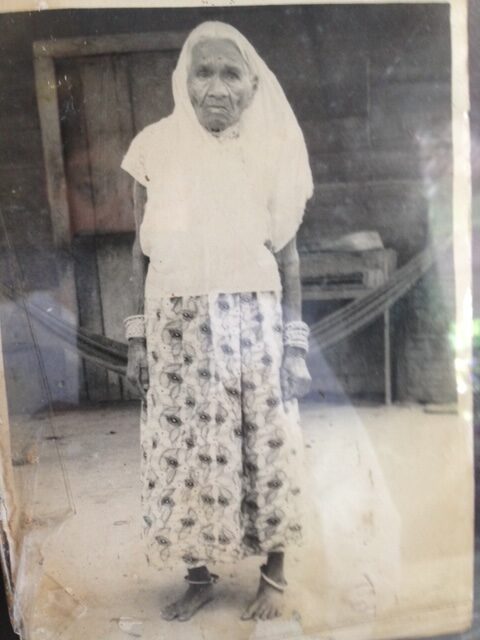
My ancestors – great-grandparents and grandparents – were indentured slaves. In the 19th century, they travelled on a ship from India to Guyana, where they worked in the sugar and rice plantations. They worked hard. This photo is of my paternal great-grandmother, barefooted and wearing her ohrni or headscarf to protect her from the searing tropical sun, a look of resigned misery and exhaustion etched across her face. I wonder if she rested?
My mother tells me that her mother, my maternal grandmother, would rise at 3am and cook for her family of nine children before heading out to the paddy fields. She had a kind and loving face, but she also looked exhausted. She died in her 50s – probably of exhaustion.
So, when I find it hard to rest, I question the narrative that is telling me I can’t rest. My daughter is the same. She’s a highly driven perfectionist (wonder where she gets that from?) who also finds it hard to rest. Months later, she still has this flu bug. She works long hours in the hospitality industry and hates calling in sick. Last week she called me in tears, saying she felt so ill, but she wanted to go in to work because she felt guilty about resting. ‘Actually,’ she said, ‘I don’t know how to rest.’
I found this a bit heart-breaking, but I also know that there is an epigenetic cycle that needs to be broken, and the work starts with me. I have to be the change, and this is how we evolve and change our DNA. If you want to know more about how behaviours and beliefs are transmitted through generations in our genes, I recommend the brilliant and highly credible work of Dr Buce Lipton, a cellular biologist and author of The Biology of Belief.
Lipton argues that we are not victims of our genetic code, but masters of our biology. He emphasises that environmental signals and conscious beliefs, not just genes, dictate our gene expression, empowering individuals to influence their health by becoming aware of their unhelpful patterns of thinking and behaving and then working on changing them.
I particularly love this quote from him:
‘You are not controlled by your genes. You are controlled by your beliefs’.
It is empowering to know that self-mastery is about living from a place of making different choices. I can be a master of my genes and not a victim of them. Just because I come from a long line of ancestry in which the need to keep going enabled my forefathers to survive, this doesn’t have to be my pattern. I definitely don’t want it to be my daughter’s pattern.
In Buddhism, these repetitive unhelpful patterns are called samskaras.
In neurophysiology, we say neurons that fire together, wire together.
And so habits stick, become ingrained in the amino acid helix of our DNA, and transmit to our children.
A World of Unrest
There’s no doubt that our world is currently in a state of unrest. We are living in crazy, heart-breaking times, and there’s a lot of fear. Even for those of us who are fortunate enough to not be living in war-torn areas, there is a collective vibe of fear, and it can feel self-indulgent to allow ourselves to rest. But it is in resting that we can, each of us, in our small individual ways, change the field of consciousness from being one of frenzy and survival to peace and thriving. In resting, we engage the parasympathetic nervous system, the branch of the vagus nerve that registers that we are safe. And so, we change the ecosystem.
If I am rested and restful, I change the ecosystem in my home.
I transmit my calm to my neighbourhood on my dog walks. To the clients I work with.
Maybe in my very presence, I can help someone else to feel calm and peaceful.
Maybe they can take that home to their ecosystem.
One tiny human fractal at a time. Creating a quieter, more peaceful world that feels safe to stop and rest.
I am going to be speaking about this next week to a group of leaders in a webinar called ‘Leader as Healer’. I’m a little nervous. How do I tell a group of left-brain management consultants, engineers, lawyers, etc. that their presence and state of being affects the culture of their teams, their organisations? I’m not entirely sure what words will emerge or what the slides will look like (or if I’ll even use any), but the one thing I can control is my state of being and presence when I deliver that session. Being well rested for the presentation will be non-negotiable.
Jim Carrey quotes the spiritual teacher Jeff Foster when he talks about depression being an absence of deep rest. You can check out the clip here.
What is Deep Rest?
What does it mean to you to rest deeply? This goes beyond going on a 2-week holiday once a year, lying on the sofa scrolling social media, or watching TV at the end of the day. Last week, I took my daughter to a hospital appointment and had to wait for an hour. I don’t enjoy hospital spaces at all – the smells, noise and lighting can be jarring on my senses.
I was reading a book on my laptop that I needed to review and was deeply absorbed. In fact, I lost myself completely in the writer’s beautifully poetic prose. Time flew by. Later, when I looked at my Oura ring data, it had registered that I’d been in deep restoration mode for an hour! This doesn’t happen easily for me. In fact, I can spend a day in a spa and hardly even register 5 minutes of restoration. Holidays can be tricky too.
So, one little step at a time, I am working on my body and mind’s ability to accept rest and uncovering what deep rest means to me. I encourage you to do the same. The world might be a crazy and chaotic place, but we are allowed to rest. I’ll leave you with Ovid’s famous and inspiring quote: ‘Take rest; a field that has rested gives a bountiful crop’.
I would love to know your thoughts on this, so please do drop me a line. What does deep rest mean to you? Do you allow yourself to do it, or do you have to fall ill in order to give yourself permission to slow down?
With love
Nerina x


